

 Domicile
Women, Money & Power: What Zimbabwe’s Financial Inclusion Strategy Really Means for You
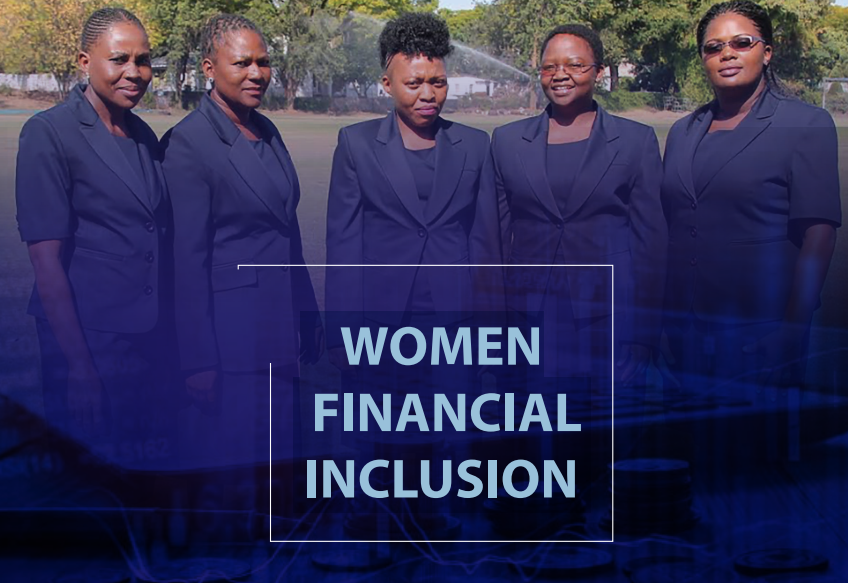
Across the world, women are rising—not just as participants in the economy, but as drivers of it. In Zimbabwe, this truth is even more powerful: women make up over half the population and are the backbone of households, businesses, and communities.
The Reserve Bank of Zimbabwe (RBZ), through its Financial Inclusion Strategy, has acknowledged something women have always known: you cannot talk about economic growth without talking about women—and you cannot empower women without giving them control over money.
But beyond the policy language, what does this actually mean for you?
The Reality: Women Are Active, But Underserved
Zimbabwean women are already deeply involved in business. In fact, past surveys show that 57% of business owners are women. Yet, only a small fraction of these businesses have access to formal banking.
This creates a powerful contradiction:
- Women are earning, trading, and saving
- But not fully benefiting from structured financial systems
Instead, many rely on informal systems—rounds, savings clubs, or expensive borrowing channels. While these systems show resilience, they often limit growth, scale, and long-term wealth creation.
The Barriers Are Real—and Structural
The RBZ document clearly outlines what women already experience daily:
- No collateral (no title deeds, no security)
- Limited access to financial information
- Complex bank requirements
- Time constraints due to unpaid care work
- Smaller, lower-risk businesses with limited growth capital
But here’s the key insight:
👉 These are not personal failures. They are system design issues.
The financial system was not originally built with women’s realities in mind.
A System Trying to Catch Up
To its credit, the RBZ has introduced several important interventions:
- The creation of the Zimbabwe Women’s Microfinance Bank
- Women-specific funding facilities and empowerment funds
- Credit guarantee schemes to reduce collateral barriers
- Plans for a collateral registry (so movable assets can be used)
- Promotion of low-cost bank accounts
- Expansion of financial literacy programs
These are not small steps—they represent a shift from exclusion to intentional inclusion.
But let’s be honest:
👉 Policy alone does not equal access. Execution is everything.
The Real Gap: Access vs. Usability
One of the most important insights in the RBZ report is this:
Access to financial services has increased—but meaningful usage still lags.
For example:
- Mobile money adoption surged (sending, receiving, withdrawing)
- But 72% of women still do not use insurance
- Many still lack access to investment products
This tells us something critical:
👉 Women are entering the system—but not yet leveraging its full power.
The Missing Link: Ownership
Here is where the conversation becomes transformative.
Financial inclusion is not just about:
- Opening accounts
- Taking loans
- Sending money
It is about ownership and control.
And this is exactly where cooperative financial models—like SACCOs and member-owned institutions—become powerful.
Because when women:
- Own the institution
- Shape the products
- Decide the priorities
They move from being customers to being stakeholders.
From Survival to Scale
The RBZ correctly points out that many women operate businesses at a subsistence level—trading, vending, small-scale services.
Why?
Because:
- Risk is high
- Capital is limited
- Household responsibilities come first
But imagine a different reality:
- Access to affordable, flexible capital
- Collective savings and investment structures
- Market linkages beyond local communities
- Financial products designed for women, by women
👉 That is how businesses move from survival to scale.
What This Means for You (Right Now)
This strategy is not just a government document—it is a signal.
A signal that:
- The system is opening (slowly)
- New financial tools are emerging
- Women are being recognized as a priority economic force
But the opportunity is not automatic.
You must position yourself to benefit.
That means:
- Becoming financially informed
- Joining structured financial communities
- Moving beyond informal systems where possible
- Thinking not just about income—but about assets, investments, and ownership
The allWomen.africa Perspective
At allWomen.africa, we see this moment clearly.
Financial inclusion is not the destination.
👉 Financial independence is.
And independence comes from:
- Access
- Knowledge
- Community
- Ownership
The future of women’s finance in Zimbabwe will not be built by policy alone.
It will be built by women who organise, participate, and take ownership of financial systems designed for them.
Final Thought
The RBZ has opened the door.
The question is:
Will women simply walk in as customers—or step in as owners of the future financial system?

Open a Cooperator Account!
Catégories
Lire la suite
Across Zimbabwe, women are already the backbone of trade—moving goods, connecting markets and supporting families and communities. Now, allWomen.africa is formalizing and scaling this power through the South Africa to Zimbabwe service, a structured, cooperative-driven trade solution that opens new doors for women not only as buyers and sellers, but as active participants in the logistics...
🌍 The 52-Week Business Masterclass: Building Women into Commodity Powerhouses Across Africa, women are active in business every day—trading, farming, producing, and selling. Yet, many remain locked out of high-value, structured markets where real wealth is created. The gap is not effort—it is access to deep, practical knowledge and clear pathways into value chains that...

From Campus to Continent: The Search for Africa’s Next Icons Begins Are you more than just a face in the crowd? Do you have a vision that extends beyond the classroom and a voice that demands to be heard? allWomen.africa, in partnership with University Competitions and Miss Campus, is officially flipping the script on campus pageantry. We are proud to announce the Future Women Leaders...

Every parent wants their child to travel safely to and from school. In urban areas, however, daily school commutes can be stressful, crowded and risky. That’s why eduBox, in partnership with uXpress SACCO, has launched the eduBox School Transport Initiative — a premium school travel service designed to provide peace of mind, comfort and safety for parents and children alike. A...

Sending children to school is more than just ensuring they have books, uniforms, and supplies — their safety and wellbeing are equally important. To give parents greater peace of mind, eduBox, in partnership with Co-op Sure Insurance Services Co-operative Society Limited and its underwriting partners, now offers eduSure — a package of insurance...