


 Cooperators
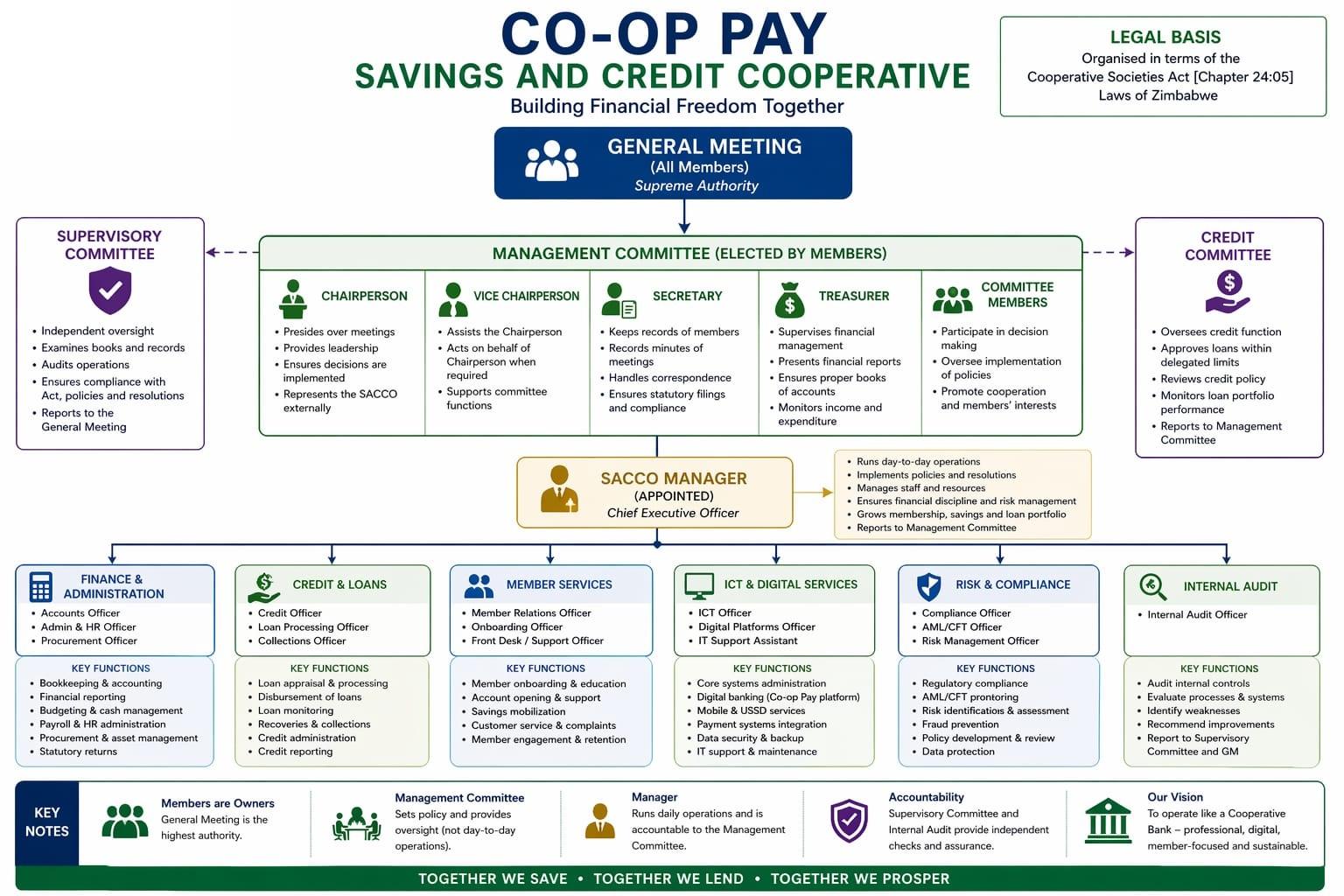
Co-op Pay Savings and Credit Cooperative is structured in line with the Cooperative Societies Act [Chapter 24:05], ensuring that it remains fully compliant while also operating efficiently as a modern, member-owned financial institution. The structure is designed to balance member control, strong governance, and professional management, allowing the SACCO to deliver services that are comparable to those offered by traditional banks, while still maintaining its cooperative identity.
At the top of the structure is the General Meeting, which consists of all members of the SACCO. This is the highest decision-making body, meaning that all major decisions ultimately rest with the members. Members elect leadership, approve key policies, and guide the direction of the Cooperative. In essence, every member is an owner, and the SACCO exists to serve the collective interests of its membership.
The members elect a Management Committee, which includes the Chairperson, Vice Chairperson, Secretary, Treasurer, and additional committee members. This committee is responsible for providing leadership, setting policies, approving budgets, and overseeing the performance of the SACCO. It is important to understand that the Management Committee does not run the daily operations of the SACCO; instead, it focuses on governance, ensuring that the organization is properly directed and accountable to its members.
Within this committee, key roles are defined to ensure proper governance. The Chairperson provides leadership and presides over meetings, the Secretary is responsible for records, communication, and compliance, and the Treasurer oversees the financial integrity of the SACCO. Together, these roles ensure that the Cooperative operates in a transparent, organized, and accountable manner.
To further strengthen oversight and protect members’ interests, the SACCO may establish additional committees such as the Supervisory Committee and the Credit Committee. The Supervisory Committee acts as an internal watchdog, auditing operations and verifying financial records, while the Credit Committee oversees lending activities to ensure that loans are issued responsibly and in line with policy. These structures are critical in maintaining trust and financial discipline within the SACCO.
The day-to-day operations of the SACCO are managed by the SACCO Manager, who is appointed by the Management Committee. The Manager is responsible for implementing policies, running operations, managing systems and staff, and driving the growth of the SACCO. This role is similar to that of a Chief Executive Officer and is essential in ensuring that the Cooperative functions efficiently and professionally.
Supporting the Manager is an operational team made up of members serving on an honorarium basis. This team covers key functional areas such as finance, credit and loans, member services, ICT and digital platforms, and risk and compliance. These functions ensure that the SACCO can deliver high-quality financial services, manage risk effectively, and provide a seamless experience to members through platforms such as Co-op Pay.
This structure allows Co-op Pay SACCO to operate on two levels simultaneously. On one level, it complies fully with the legal and governance requirements of the Cooperative Societies Act, with members in control and elected leadership providing oversight. On another level, it operates like a modern financial institution, with a professional management team, structured departments, and digital systems supporting its services. This is what enables the SACCO to function as a “cooperative bank in practice.”
To maintain this balance, certain governance principles must always be observed. Committee members are elected and serve in an oversight capacity, while the Manager is appointed to handle operations. Financial accountability, proper record-keeping, and transparency are essential at all levels. This separation of roles ensures that power remains with the members while allowing the SACCO to operate efficiently and grow sustainably.
For members, this structure means more than just access to financial services. It means ownership, participation, and the opportunity to be part of building a new model of banking in Zimbabwe. Through the Cooperator Account and the broader Co-op Pay ecosystem, the SACCO aims to deliver inclusive, high-quality financial services that empower members and strengthen the cooperative movement.
At the top of the structure is the General Meeting, which consists of all members of the SACCO. This is the highest decision-making body, meaning that all major decisions ultimately rest with the members. Members elect leadership, approve key policies, and guide the direction of the Cooperative. In essence, every member is an owner, and the SACCO exists to serve the collective interests of its membership.
The members elect a Management Committee, which includes the Chairperson, Vice Chairperson, Secretary, Treasurer, and additional committee members. This committee is responsible for providing leadership, setting policies, approving budgets, and overseeing the performance of the SACCO. It is important to understand that the Management Committee does not run the daily operations of the SACCO; instead, it focuses on governance, ensuring that the organization is properly directed and accountable to its members.
Within this committee, key roles are defined to ensure proper governance. The Chairperson provides leadership and presides over meetings, the Secretary is responsible for records, communication, and compliance, and the Treasurer oversees the financial integrity of the SACCO. Together, these roles ensure that the Cooperative operates in a transparent, organized, and accountable manner.
To further strengthen oversight and protect members’ interests, the SACCO may establish additional committees such as the Supervisory Committee and the Credit Committee. The Supervisory Committee acts as an internal watchdog, auditing operations and verifying financial records, while the Credit Committee oversees lending activities to ensure that loans are issued responsibly and in line with policy. These structures are critical in maintaining trust and financial discipline within the SACCO.
The day-to-day operations of the SACCO are managed by the SACCO Manager, who is appointed by the Management Committee. The Manager is responsible for implementing policies, running operations, managing systems and staff, and driving the growth of the SACCO. This role is similar to that of a Chief Executive Officer and is essential in ensuring that the Cooperative functions efficiently and professionally.
Supporting the Manager is an operational team made up of members serving on an honorarium basis. This team covers key functional areas such as finance, credit and loans, member services, ICT and digital platforms, and risk and compliance. These functions ensure that the SACCO can deliver high-quality financial services, manage risk effectively, and provide a seamless experience to members through platforms such as Co-op Pay.
This structure allows Co-op Pay SACCO to operate on two levels simultaneously. On one level, it complies fully with the legal and governance requirements of the Cooperative Societies Act, with members in control and elected leadership providing oversight. On another level, it operates like a modern financial institution, with a professional management team, structured departments, and digital systems supporting its services. This is what enables the SACCO to function as a “cooperative bank in practice.”
To maintain this balance, certain governance principles must always be observed. Committee members are elected and serve in an oversight capacity, while the Manager is appointed to handle operations. Financial accountability, proper record-keeping, and transparency are essential at all levels. This separation of roles ensures that power remains with the members while allowing the SACCO to operate efficiently and grow sustainably.
For members, this structure means more than just access to financial services. It means ownership, participation, and the opportunity to be part of building a new model of banking in Zimbabwe. Through the Cooperator Account and the broader Co-op Pay ecosystem, the SACCO aims to deliver inclusive, high-quality financial services that empower members and strengthen the cooperative movement.
Co-op Pay Savings and Credit Cooperative is structured in line with the Cooperative Societies Act [Chapter 24:05], ensuring that it remains fully compliant while also operating efficiently as a modern, member-owned financial institution. The structure is designed to balance member control, strong governance, and professional management, allowing the SACCO to deliver services that are comparable to those offered by traditional banks, while still maintaining its cooperative identity.
At the top of the structure is the General Meeting, which consists of all members of the SACCO. This is the highest decision-making body, meaning that all major decisions ultimately rest with the members. Members elect leadership, approve key policies, and guide the direction of the Cooperative. In essence, every member is an owner, and the SACCO exists to serve the collective interests of its membership.
The members elect a Management Committee, which includes the Chairperson, Vice Chairperson, Secretary, Treasurer, and additional committee members. This committee is responsible for providing leadership, setting policies, approving budgets, and overseeing the performance of the SACCO. It is important to understand that the Management Committee does not run the daily operations of the SACCO; instead, it focuses on governance, ensuring that the organization is properly directed and accountable to its members.
Within this committee, key roles are defined to ensure proper governance. The Chairperson provides leadership and presides over meetings, the Secretary is responsible for records, communication, and compliance, and the Treasurer oversees the financial integrity of the SACCO. Together, these roles ensure that the Cooperative operates in a transparent, organized, and accountable manner.
To further strengthen oversight and protect members’ interests, the SACCO may establish additional committees such as the Supervisory Committee and the Credit Committee. The Supervisory Committee acts as an internal watchdog, auditing operations and verifying financial records, while the Credit Committee oversees lending activities to ensure that loans are issued responsibly and in line with policy. These structures are critical in maintaining trust and financial discipline within the SACCO.
The day-to-day operations of the SACCO are managed by the SACCO Manager, who is appointed by the Management Committee. The Manager is responsible for implementing policies, running operations, managing systems and staff, and driving the growth of the SACCO. This role is similar to that of a Chief Executive Officer and is essential in ensuring that the Cooperative functions efficiently and professionally.
Supporting the Manager is an operational team made up of members serving on an honorarium basis. This team covers key functional areas such as finance, credit and loans, member services, ICT and digital platforms, and risk and compliance. These functions ensure that the SACCO can deliver high-quality financial services, manage risk effectively, and provide a seamless experience to members through platforms such as Co-op Pay.
This structure allows Co-op Pay SACCO to operate on two levels simultaneously. On one level, it complies fully with the legal and governance requirements of the Cooperative Societies Act, with members in control and elected leadership providing oversight. On another level, it operates like a modern financial institution, with a professional management team, structured departments, and digital systems supporting its services. This is what enables the SACCO to function as a “cooperative bank in practice.”
To maintain this balance, certain governance principles must always be observed. Committee members are elected and serve in an oversight capacity, while the Manager is appointed to handle operations. Financial accountability, proper record-keeping, and transparency are essential at all levels. This separation of roles ensures that power remains with the members while allowing the SACCO to operate efficiently and grow sustainably.
For members, this structure means more than just access to financial services. It means ownership, participation, and the opportunity to be part of building a new model of banking in Zimbabwe. Through the Cooperator Account and the broader Co-op Pay ecosystem, the SACCO aims to deliver inclusive, high-quality financial services that empower members and strengthen the cooperative movement.
0 Comments
·0 Shares
·745 Views
·0 Reviews