

 Home
Home
Analysis of Statutory Instrument 59 of 2026 and the allWomen.africa Value Proposition
1. Overview of the Statutory Instrument
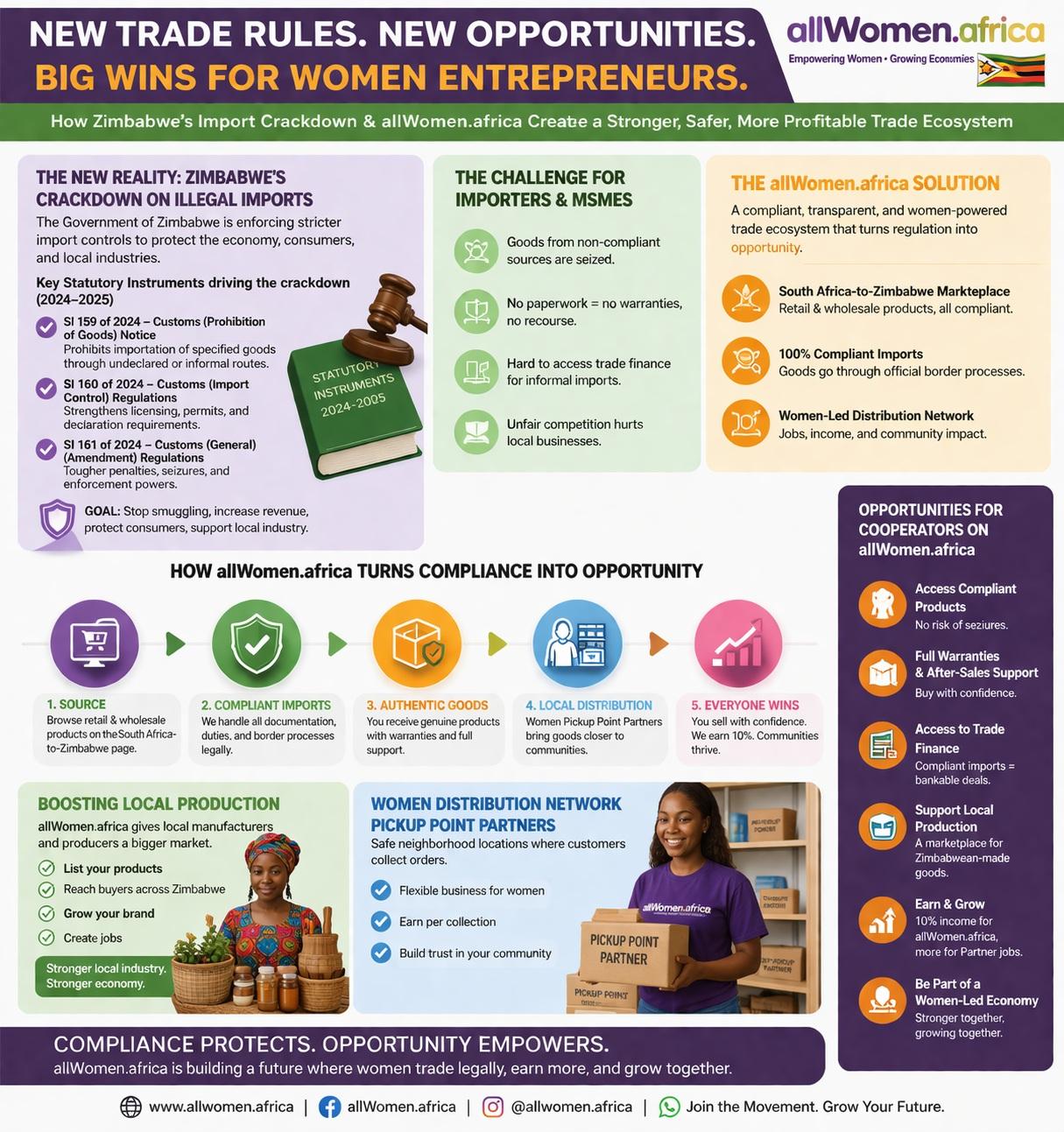
In March 2026, the Government of Zimbabwe introduced Statutory Instrument 59 of 2026, which consolidates import licensing under one unified framework in order to support local industry, improve regulatory compliance and simplify previously fragmented import requirements. The Minister of Industry and Commerce described this new SI as a way to streamline import procedures, reduce bureaucratic duplication and support domestic production by requiring prior approval for a broad range of imported goods. This includes items such as footwear, processed foods, packaging materials, steel products, pharmaceuticals and other categories where Zimbabwe has local production capacity or aims to build it up.
Unlike an outright ban on imports, SI 59 is a management mechanism — goods can still be imported legally, but licences and fees are enforced and products must go through formal channels rather than informal or unregulated entry.
This clampdown reflects a broader move within Zimbabwe to regulate imports more strictly, reduce reliance on informal trade and protect local industry — similar to previous bans on second‑hand clothing and informal vending that authorities have implemented to formalise the economy.
2. How allWomen.africa Supports the Government’s Strategy
Statutory Instrument 59’s core aims are:
- Promote legal and transparent imports
- Protect and grow domestic production
- Strengthen compliance and supply chain integrity
allWomen.africa’s South Africa‑to‑Zimbabwe initiative directly supports these objectives:
a. Formalised Import Pathways
The platform provides a legal, documented import route for products ordered by Zimbabwean women from South African suppliers. Rather than relying on informal smuggling or unofficial delivery channels that can lead to goods being seized or declined at borders, allWomen.africa ensures:
- Proper licensing and documentation are obtained
- Taxes and duties are cleared at entry
- Goods meet all regulatory requirements
This means all deliveries are compliant with SI 59’s consolidated import licensing process — reducing delays, fines and legal risk for participants.
b. Support for Local Industry
SI 59 is designed to encourage local production where possible, but it allows imports where Zimbabwean industry cannot fully meet demand. allWomen.africa complements this by:
- Uploading retail and wholesale products that are compliant with Zimbabwe’s import regulations
- Ensuring quality and legal entry, which preserves market credibility
- Giving Zimbabwean MSMEs the chance to sell locally and build formal distribution networks once products are imported
3. Opportunities and Advantages for Cooperators on allWomen.africa
a. Access to Compliance‑Assured Imports
Products brought in through the allWomen.africa platform are imported with the correct licences and customs clearance — meaning:
- No risk of confiscation at the border
- Documentation that supports after‑sale warranties and service
- Enhanced trust and authenticity for customers
In contrast, informal imports often lack this documentation, making it difficult to claim warranty, returns, or valid proof of origin.
b. Higher Product Integrity and Trade Finance Eligibility
Formal documentation and compliance open doors beyond just market access:
- Banks and financiers are far more willing to support MSMEs when goods are legally imported and documented
- Formal channels make it possible to access trade finance, since lenders can verify that products are stored, cleared and legally transacted
- Cooperators using the platform are positioned for growth‑oriented funding, rather than relying on informal credit arrangements
This addresses a major constraint in informal cross‑border trade, where lack of documentation makes formal financing difficult or impossible — pushing many traders into high‑cost, informal credit circles.
c. Promotion of Local Manufacturers and MSMEs
By linking Zimbabwean consumers and buyers with a structured supply chain, the initiative also encourages:
- Visibility for local products
- Opportunities for Zimbabwean manufacturers and suppliers to place products on the platform
- Collaboration between informal retailers transitioning into formal markets
This aligns with the government’s goal of stabilising markets and supporting domestic production while still meeting consumer demand where local production doesn’t yet satisfy it.
d. Strengthened Consumer Protection
SI 59’s consolidated regime aims to ensure product safety and standards are upheld. allWomen.africa supports this through:
- Verification of authentic goods
- Protection against counterfeit or sub‑standard imports
- Structured supply chains that meet regulatory and consumer standards
Consumers benefit from safer, better‑regulated products — while MSMEs benefit from operating within those same standards.
4. Summary: How This Benefits Cooperators
|
Area |
Opportunity Created by SI 59 + allWomen.africa |
|
Compliance |
Legal import pathways reduce risk and enhance long‑term trading viability |
|
Market Access |
Women can access quality products previously stuck in informal trade |
|
Business Growth |
MSMEs can build portfolios, formal storefronts and expand networks |
|
Finance Access |
Formal documentation enables better access to credit and trade finance |
|
Consumer Protection |
Authentic goods with warranties increase customer trust |
|
Local Industry Support |
Balances import needs while encouraging demand for local production |
Conclusion
The introduction of Statutory Instrument 59 of 2026 represents a pivotal shift in Zimbabwe’s trade environment — formalising imports, protecting consumers and supporting domestic production through regulatory compliance.
The allWomen.africa South Africa‑to‑Zimbabwe initiative is directly aligned with this approach, transitioning informal trade into a cooperative, compliant framework. By managing licensing, legal import clearance and authenticated deliveries — and by creating new income streams for Cooperators — allWomen.africa not only supports government policy but unlocks opportunities for MSMEs, improves consumer confidence and lays the groundwork for sustainable regional trade growth.
Open a Cooperator Account!
Categories
Read More
By Tsitsi Ndabambi - February 28, 2025 A life changing occurrance took place on Thursday, February 27, 2025, at Monomotapa Hotel in Harare when the Women’s Microfinance Bank (ZWMB) took a major step towards financial inclusion and economic empowerment for women by launching allWomen.co.zw, a digital platform designed to support female entrepreneurs. The event, backed...
Zimbabwe Women Microfinance bank, created with a special mission to empower women economically and socially by offering access to savings, loans, and financial tools that many had never experienced before, became a game changer for Fadzai an entrepreneur in Chiredzi who had struggled financially to sustain her enterprise. Fadzai, a 27-year-old entrepreneur, is among many female entrepreneurs...
At eduBox, we believe that preparing children for school goes beyond delivering books, uniforms, and supplies. It’s also about equipping them with the knowledge and skills they’ll need for life. That’s why we’re proud to introduce eduBox Money Matters — a free financial literacy course offered to every child who receives an eduBox. What is eduBox Money...
Back-to-school season often comes with financial pressure for parents and guardians. To ease the burden, uXpress SACCO has introduced eduCredit, a flexible financing solution designed for families ordering their eduBox Back-to-School Supplies. With eduCredit, parents can order all their child’s school requirements upfront and spread payments over three months at just 10% interest on the...